
Kamatera vs Hetzner vs Linode Cloud Account: The Ultimate 2025 Comparison for VPS Hosting
In the fast-evolving world of cloud computing, choosing the right VPS provider can make or break your online project. Whether you’re launching a startup website, scaling a development environment, or managing enterprise-level applications, the decision between Kamatera, Hetzner, and Linode cloud accounts boils down to factors such as pricing, performance, scalability, and support. As of October 2025, these three providers stand out for their reliability and innovation, but each caters to different needs.
Kamatera excels in customizable, high-performance setups with global reach. Hetzner dominates the budget-conscious market with unbeatable value and European roots. Linode, now powered by Akamai’s edge network, shines for developers seeking seamless integrations and low-latency apps. This in-depth guide to Kamatera, Hetzner, and Linode cloud accounts draws on hands-on benchmarks, user reviews, and official updates to help you make an informed decision. We’ll break down features, costs, and real-world performance to ensure you pick the best cloud account for your goals. By the end, you’ll know which provider aligns with your budget and workload—let’s dive in.
What is a Cloud Account, and Why Compare These Providers?
A cloud account in the context of VPS hosting refers to your personalized dashboard for managing virtual private servers (VPS), storage, networks, and add-ons. It’s the gateway to scalable resources without the overhead of physical hardware. Providers like Kamatera, Hetzner, and Linode offer these accounts with varying degrees of flexibility, making them ideal for a range of applications, from personal blogs to AI-driven workloads.
Why compare Kamatera, Hetzner, and Linode cloud accounts specifically? In 2025, the cloud market is saturated, but these three consistently rank high in uptime (99.9%+), security, and developer satisfaction. Kamatera appeals to enterprises needing instant scaling, Hetzner to cost-savvy users in Europe, and Linode to global teams leveraging edge computing. Recent benchmarks show Hetzner edging out on raw speed for small sites, while Kamatera and Linode tie for enterprise scalability. With the rising demand for AI and edge applications, understanding these differences is crucial for optimizing your cloud account setup.
Kamatera Cloud Account: Flexibility Meets Power
Kamatera has built a reputation as a powerhouse for customizable cloud infrastructure since its inception. In 2025, its cloud account dashboard remains intuitive, enabling users to deploy servers in under 60 seconds across 13 global data centers, from New York to Hong Kong. This makes it ideal for international businesses that require low-latency access.
Key strengths include unlimited scaling: Start with a bare VPS and add RAM, CPU, or storage on the fly without downtime. Powered by Intel Xeon processors and NVMe SSDs, Kamatera’s servers deliver blistering speeds, with benchmarks clocking in at over 10,000 IOPS for I/O tasks. Features such as managed cloud services, load balancers, and AI-optimized instances cater to a diverse range of use cases, from e-commerce backends to machine learning pipelines.
Pricing is a highlight: Hourly billing starts at $0.005 per hour (about $4 monthly for entry-level plans), with no long-term contracts. A 30-day free trial lets you test a complete Kamatera cloud account risk-free, covering up to $100 in credits. Users praise its 100% uptime and 24/7 expert support via chat or phone, though some note the interface can feel overwhelming for absolute beginners.
For developers, pre-built templates for WordPress, databases, and ERP systems streamline the setup process, reducing the time and effort required to configure these systems. Security shines with built-in firewalls and DDoS mitigation, ensuring your cloud account stays robust against threats. Overall, Kamatera scores 4.7/5 in 2025 reviews for its balance of power and affordability. If customization is your priority, this provider’s cloud account won’t disappoint.
Hetzner Cloud Account: Budget-Friendly Performance Giant
Hetzner, a German-based provider, continues to disrupt the market in 2025 with its no-frills approach to cloud hosting. Its cloud account portal is straightforward, emphasizing quick server spins and automation via API/CLI tools. With data centers in Germany, Finland, the US, and Singapore, it covers key regions without the premium price tag.
What sets Hetzner apart is its hardware: servers run on AMD EPYC or Intel Xeon processors with NVMe SSDs in RAID 10 arrays, delivering sub-millisecond latencies ideal for gaming or high-traffic sites. Options range from shared vCPU plans for light workloads to dedicated CCX instances for intensive tasks, such as big data processing. Freebies abound—DDoS protection, firewalls, and 20TB monthly traffic in Europe make it a steal.
Pricing starts at per month for shared plans, with hourly rates available for flexible use (capped monthly to avoid unexpected charges). Block storage costs just €0.044/GB, and snapshots cost pennies. Although there is no money-back guarantee, the low entry barrier suits tinkerers. Support is ticket-based and responsive, although live chat is absent—an acceptable option for professionals but a hurdle for newcomers.
In benchmarks, Hetzner outperforms pricier rivals in sysbench CPU tests by up to 20%, thanks to its efficient Arm64 options. GDPR compliance and open-source integrations (up to €50 credits) appeal to EU devs. For value-driven users, a Hetzner cloud account is unbeatable, earning 4.6/5 stars for reliability.
Linode Cloud Account: Developer-Centric Edge Computing
Linode, acquired by Akamai in 2022, is expected to evolve into a leader in distributed cloud services by 2025. Its cloud account integrates Akamai’s edge network for ultra-low latency, making it a go-to solution for global applications such as streaming or IoT. The dashboard is developer-friendly, with one-click deploys for Kubernetes, databases, and GPUs.
Core offerings include Essential Compute (high-memory plans), Managed Databases and Object Storage. Powered by second-gen AMD EPYC, servers hit 99.99% uptime with free inbound transfers and low egress fees. Scalability is effortless—auto-scale across 11+ regions, from Tokyo to Frankfurt.
Flat pricing starts at $5 per month for Nanode plans (1GB RAM, one vCPU), which bundle CPU, RAM, and 1TB transfer. There are no hidden fees, and new users are eligible for a $100 credit. Support is top-tier: 24/7 chat, phone, and a vast knowledge base. However, some users report occasional strict policies on resource limits.
Linode excels in integrations—Marketplace apps for WordPress or Docker save hours. Security features, such as VPCs and backups (which account for 20% of instance cost), help keep things locked down. In 2025 reviews, it scores 4.5/5 for ease of use, particularly following the enhancements by Akamai. For teams building modern apps, a Linode cloud account delivers edge without complexity.
Head-to-Head: Kamatera vs Hetzner vs Linode Cloud Account Breakdown
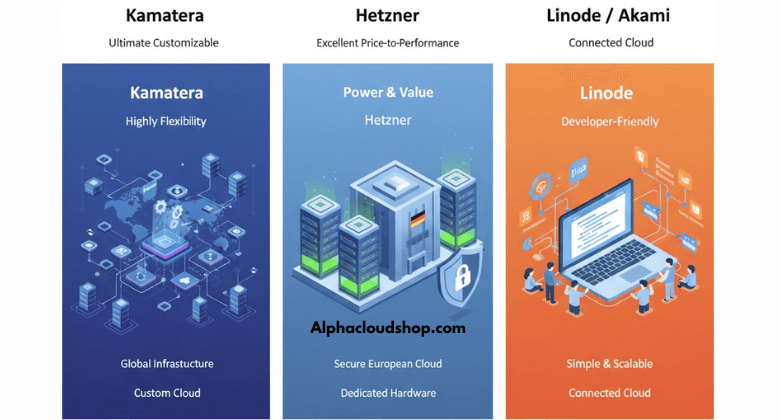
Pricing Showdown
Cost is king in VPS hosting. Hetzner leads with entry plans at €3.79/mo, ideal for bootstrappers—20% cheaper than Linode’s $5 Nanode. Kamatera matches closely at $4/ 4/month but shines with hourly flexibility ($0.005/hour), perfect for bursty workloads. Linode’s flat model includes generous transfers (1TB free), which reduces long-term costs for data-intensive users. For a mid-tier 4 vCPU/8GB RAM setup, expect to pay $20-$ 30 per month across all providers, but Hetzner offers the most savings on add-ons, such as storage.
| Provider | Starting Price | Billing Model | Free Trial/Credits |
|---|---|---|---|
| Kamatera | $4/mo | Hourly/Monthly | 30 days ($100) |
| Hetzner | €3.79/mo | Hourly (capped) | None |
| Linode | $5/mo | Monthly | $100 credits |
Performance and Reliability
Benchmarks from VPSBenchmarks reveal Hetzner topping web latency tests (under 50ms in EU), thanks to NVMe RAID. Kamatera follows with 100% uptime and 10Gbps ports, edging Linode in raw CPU (sysbench scores 15% higher). Linode counters with Akamai’s CDN for global speeds, hitting 99.99% SLA. All three handle 1,000+ concurrent users flawlessly, but Hetzner lags slightly in US regions.
Features and Scalability
Kamatera offers the most customization—add GPUs or private clouds instantly. Hetzner provides free load balancers and snapshots, which are ideal for Kubernetes clusters. Linode dominates managed services (e.g., LKE for containers), with seamless edge deploys. Scalability? All auto-scale, but Kamatera’s unlimited resources are the winner for enterprises.
Customer Support and Ease of Use
Linode’s 24/7 chat service earns rave reviews (4.8/5 response time). Kamatera’s experts handle complex queries, while Hetzner’s tickets are efficient but slower (no chat). Dashboards: Linode’s is most intuitive for developers; Hetzner’s is the simplest for basics; Kamatera’s is feature-rich but has a steeper curve.
Security and Compliance
All include firewalls and DDoS protection. Hetzner adds free hardware mitigation; Kamatera excels in VPCs; Linode’s edge security thwarts global threats. GDPR compliance is standard, with Linode offering DPAs for US ops.
Pros and Cons: Quick Reference
- Kamatera Pros: Ultra-customizable, global DCs, free trial. Cons: Interface complexity, higher add-on costs.
- Hetzner Pros: Cheapest, high I/O speeds, free extras. Cons: Limited support channels, EU-focused.
- Linode Pros: Developer tools, edge network, flat pricing. Cons: Stricter limits, post-acquisition tweaks.
Who Should Choose Which Cloud Account?
Solo devs on a shoestring? Go Hetzner for raw value. Enterprises needing tweaks? Kamatera’s your match. Global teams building apps? Linode’s edge seals it. Test via trials to confirm.
Conclusion
Choosing between Kamatera, Hetzner, and Linode Cloud Accounts depends on your specific needs for performance, scalability, pricing, and support. Kamatera offers highly customizable cloud servers with flexible pricing, making it an ideal choice for businesses that require tailored solutions and global data center options. Hetzner stands out for its cost-effective, high-performance dedicated servers and reliable infrastructure, making it particularly appealing to budget-conscious users in Europe. Linode, now part of Akamai, offers a developer-friendly platform with consistent pricing and robust features, ideal for startups and developers who prioritize simplicity and scalability. Evaluate your project requirements, such as compute power, geographic reach, and support needs, to determine which provider best aligns with your goals.
Frequently Asked Questions
1. What are the main differences between Kamatera, Hetzner, and Linode Cloud Accounts?
Kamatera emphasizes flexibility with customizable cloud servers and a wide range of global data centers. Hetzner focuses on affordable, high-performance dedicated and cloud servers, primarily in Europe. Linode offers straightforward pricing, developer-friendly tools, and reliable cloud infrastructure with global availability.
2. Which provider is best for startups looking for a Kamatera vs Hetzner vs Linode Cloud Account comparison?
Startups often prefer Linode due to its simple pricing, extensive documentation, and developer-focused features. Kamatera suits startups needing highly customizable resources, while Hetzner is ideal for those prioritizing low-cost, high-performance servers.
3. How do Kamatera, Hetzner, and Linode compare in terms of pricing?
Hetzner typically offers the lowest prices, especially for dedicated servers. Kamatera’s pricing is flexible but can be higher due to its customization options. Linode provides predictable, competitive pricing, making budgeting easier for consistent workloads.
4. Which provider has the best global data center coverage in the Kamatera vs Hetzner vs Linode comparison?
Kamatera has the broadest global data center network, with locations across North America, Europe, Asia, and the Middle East. Linode also offers strong international coverage, while Hetzner’s data centers are primarily concentrated in Europe, with limited options elsewhere.
5. Are there significant performance differences between Kamatera, Hetzner, and Linode Cloud Accounts?
All three providers deliver strong performance, but Hetzner’s dedicated servers often provide superior raw compute power at a comparable price. Kamatera’s customizable hardware allows for optimized performance, while Linode offers consistent performance with a focus on ease of use.
6. Which provider offers better customer support for a Cloud Account?
Linode is known for its responsive, developer-oriented support and extensive community resources. Kamatera offers 24/7 managed support, ideal for businesses that require hands-on assistance. Hetzner’s support is reliable but less comprehensive, often requiring users to possess more technical expertise.
7. Can I scale resources easily with Kamatera, Hetzner, or Linode Cloud Accounts?
All three providers support resource scaling. Kamatera excels in granular customization, allowing precise adjustments. Linode offers seamless vertical and horizontal scaling, while Hetzner provides scalable options, though its focus is more on fixed configurations for dedicated servers.